
The first time someone bought a pattern from me and then emailed to ask, very politely, whether they were “allowed” to put it on tote bags and sell them at a market, I felt two things at once. First: yes, obviously, please, that is the entire point. Second: oh no — if they had to ask, my license wasn't doing its job.
So I rewrote it. And then I kept getting the question anyway, phrased eleven different ways, because the real problem isn't any one shop's wording. It's that “commercial use” is a phrase everybody uses and almost nobody defines, and the people it matters most to are makers who are about to spend money on blanks.
Let's fix that.
Short version: a commercial-use license on a digital pattern means you may sell physical or digital products that you make with the pattern — mugs, fabric, cards, packaging, client work — but you may not sell or give away the pattern file itself. You are buying the right to use the artwork, not the artwork. Almost every dispute in this space comes down to that one distinction, and once you can see it, most license documents become readable.
The second thing to check, and the one people skip, is whether there's a quantity cap. Plenty of licenses have one. Mine does — 5,000 finished pieces per design — and I'll show you exactly where that number sits and what it counts further down.
What does “commercial use” actually mean on a digital download?
Commercial use is permission to earn money from things you create using a file, granted to you and not transferable to anyone else. It is a permission slip, not a transfer of ownership. The artist still owns the artwork; you own the right to put it to work.
That framing matters because it predicts the answer to almost every follow-up question. Can I sell mugs with it? You're making something — yes. Can I share the download folder with my business partner? You're transferring the file — no. Can I use it in a logo for a client? Making, and paid work — usually yes, check attribution. Can I upload it to my own shop as a digital paper pack? Transferring, in the most direct way possible — absolutely not.
Personal use, by contrast, means exactly what it sounds like: make things for yourself, your kitchen, your kid's birthday party. Nothing changes hands for money. A lot of free downloads around the internet are personal-use only, and that's a completely fair thing for someone to offer — it's just not the same product as a commercial license, and it catches people out when they've already printed 200 stickers.
What can you actually sell with a pattern you bought?
Here's what my own licenses say, laid out side by side, because I'd rather you read the real terms than a vibe. These are the current small-business licenses that come in the download with every Digisperse product — every product's download includes a plain-language license certificate that says exactly this, and the full legal terms live at digisperse.com/license.
| Product line | Finished pieces per design | Paid client work | Attribution | Specifically not allowed |
|---|---|---|---|---|
| Patterns & digital papers | Up to 5,000 | Yes | Not required | Reselling the pattern files as-is; selling it on as digital paper, clip art or a download |
| Clip art & graphics | Up to 5,000 | Yes | Not required | Redistributing the graphics as-is (files or cut stickers); selling the elements as a graphics pack |
| Color palettes | Up to 5,000 | Yes | Not required | Sharing the palette files; selling the palette as-is as a swatch or color product |
Three different product lines, one shape. Make things, sell things, don't hand the raw file to anyone else, and email me if you're going past 5,000 of one design (yourfriend@digisperse.com — an extended license is a normal, boring, yes-of-course conversation, not a telling-off).
One note on that table so it's honest: those are my terms. Other shops cap at 100 pieces, or 500, or don't cap at all, or require credit, or exclude print-on-demand platforms entirely. The row you need is always the row in the license you actually bought.
If you want the four free downloads I wish someone had handed me when I started selling — including the reference sheets I still keep open while I work — the Color-Confident Crafter Kit is yours for an email. I only write when I've got something worth the interruption.
The line everyone trips over: making versus redistributing
If you only keep one idea from this, keep this one. Ask yourself whether the buyer ends up with the file or with a thing.
They end up with a thing: a printed tea towel, a wrapped candle, a run of business cards, a wedding suite you designed for a paying couple, a phone case on a print-on-demand site, a mug, a sticker you cut and sold. All fine. That's the license working as intended.
They end up with the file: you sold the PNG, you bundled it into a “digital paper pack,” you dropped it in a shared Drive folder for your Etsy team, you put it in a free-resources post, you included the raw tile as a bonus with a template. Not fine — and mostly not fine at every shop, not just mine.
The murky middle is real, though, and I don't want to pretend otherwise. An editable Canva template with the pattern baked into the background is closer to “a thing” than to “the file,” but the buyer can often pull the image back out of it. A digital planner with patterned covers has the same issue. My own read: if the pattern is extractable at usable resolution, treat it as redistribution and ask first. Asking costs an email. Guessing wrong costs a takedown and a very awkward refund week.
(I have had that week. Not over a pattern, over something sillier, and I still think about it while I'm trying to fall asleep.)
What does “5,000 pieces per design” actually count?
Quantity caps confuse people more than they should, mostly because the phrasing sounds like it's tracking something enormous and official. It isn't. It's a ceiling, it's per design, and for the overwhelming majority of small makers it will never come up.
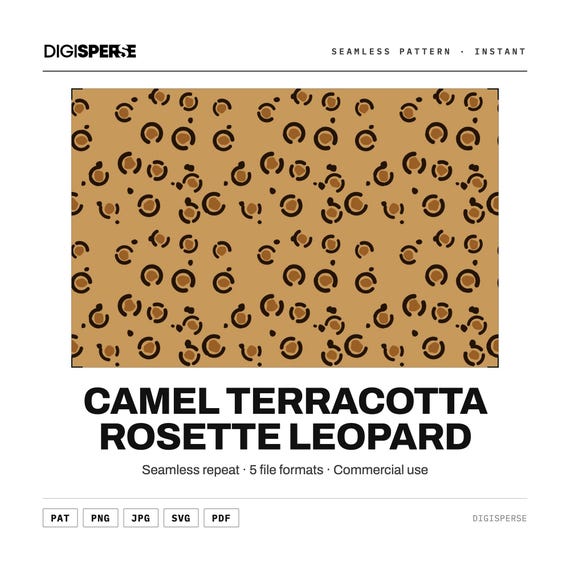
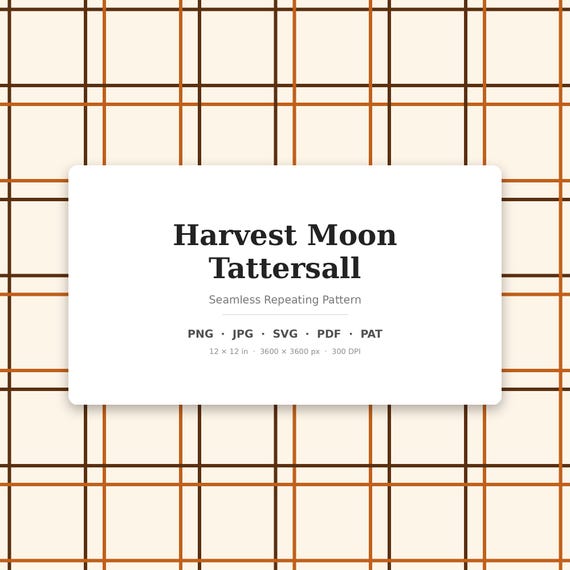
Under my license it counts finished pieces you sell — 5,000 of them, per individual design, not 5,000 across everything you own. So: 4,000 mugs using the leopard rosette and 4,000 notebooks using the tattersall plaid is eight thousand objects and two designs, and it's fine. Twelve thousand mugs of the same leopard is one design over the cap, and that's the email.
It does not count the samples you made and ruined, the ones you gave to your mum, the mockups on your listing photos, or the fourteen test prints where the color was off. Sold pieces. That's the counter.
Here's the honest trade on the products themselves. A seamless repeat that actually tiles — no visible seam, no drift, sized so it scales without turning to mush — takes real time to build and more time to test, and testing is the part people skip. The Camel Terracotta Rosette Leopard pattern and the Harvest Moon Tattersall plaid both come as PNG, JPG, SVG and PDF, tile-tested, with the small-business license in the download so you're not hunting for it later. You could absolutely build a leopard repeat yourself. I've built a lot of them, and the tiling is fiddlier than it looks. If you'd rather spend the evening making the product instead of chasing a one-pixel seam, take mine.
How to check any shop's license in about two minutes
Not just mine. This is the routine I use before I buy anything I intend to sell with, and it's short enough that there's no excuse for skipping it.
1. Find the license before you buy, not after. Good shops put it in the listing description or link it. If you genuinely cannot find one, that absence is the answer — message the seller, and if they can't produce it, buy elsewhere.
2. Search the document for four words. “Resell.” “Redistribute.” “Attribution” or “credit.” And a number — any number with “pieces,” “units” or “items” near it. Four searches, and you've found roughly ninety percent of what can bite you.
3. Check whether print-on-demand is named. Some licenses treat POD platforms differently from things you make with your own hands, because the platform is technically holding a copy of the file. If you sell through a POD service, this is your riskiest line and it's worth reading twice.
4. Save the license with the files. Same folder, every time. In two years, when a marketplace asks you to prove you had the right to use an image, a PDF in the right folder is the difference between a two-minute reply and a very bad afternoon.
That's it. Four steps, and the fourth one is the one you'll thank yourself for.
The part I don't have tidy
AI training and AI-assisted work. Whether feeding a purchased pattern into a generative tool counts as use or as redistribution is not settled anywhere I trust, and the confident takes I've read on both sides are mostly confident about the part they'd prefer to be true.
My license doesn't currently address it, which is a gap and I know it. My working position — not legal advice, just what I'd tell a friend — is that generating derivative artwork from someone's file and then selling that output is closer to redistribution than to making, and I wouldn't do it without asking. I'll update the license when I can write something I'd actually stand behind rather than something that sounds decisive.
Frequently asked questions
Can I sell products made with a seamless pattern I bought?
Yes, if the pattern came with a commercial-use license. That license lets you sell finished products you make with it — fabric, mugs, cards, packaging, apparel, client work. What it does not let you do is sell or share the pattern file itself. Check the license for a quantity cap before a big run; mine allows up to 5,000 finished pieces per design.
What is the difference between personal use and commercial use?
Personal use means you can make things for yourself and the people around you, with no money changing hands. Commercial use means you can sell what you make. Many free downloads are personal-use only, so it is worth confirming before you buy blanks or print inventory.
Do I have to credit the designer when I use a pattern commercially?
It depends entirely on the license. Digisperse licenses do not require attribution — you can use the files in personal, commercial and paid client work without crediting me. Other shops do require credit, sometimes in a specific format, so search the license document for the word “attribution” or “credit” before you assume.
Can I use a purchased pattern on print-on-demand sites?
Usually yes, but this is the line worth reading twice. Print-on-demand is selling a finished product, which commercial licenses generally allow, but some licenses name POD platforms specifically and treat them differently because the platform stores a copy of your artwork. If the license does not mention it, ask the seller rather than guessing.
What happens if I go over the piece limit in a license?
You email the designer and buy an extended license. It is a routine transaction, not a penalty — most independent sellers would be genuinely pleased that a design sold that well. For Digisperse products that is yourfriend@digisperse.com. Selling past the cap without one is a license breach, which is worth avoiding for reasons that have nothing to do with anyone being cross with you.
Keep making
- Seamless Digital Paper: How to Use It Without the Seam Showing
- Canva Background Patterns: How to Tile One Properly (and Not Stretch It)
- SVG vs PNG vs PDF: Which File Do You Actually Need?
Everything in my shop ships with the same small-business license in the download folder, which means the answer to “can I sell this?” travels with the files instead of living in a listing you'll never scroll back to. If you're building a product line rather than a one-off, the Shapes SVG Bundle gives you ten clean vector basics to build on, and the Quiet Luxury Neutral Color Palette keeps thirty neutrals consistent across your packaging, your listings and your shop banner — same license, same 5,000-piece allowance. And if you'd rather start with nothing in the cart, the Color-Confident Crafter Kit is four free downloads for one email.
Go find the license for the last file you bought and see whether you can answer the four questions above in two minutes. If you can't — and I'd bet a mug on at least one of them — tell me which one tripped you, because that's the wording I'll fix in mine next.
Keep it sunny,
— Kassie
About the maker: Hi, I'm Kassie — the one-woman team behind Digisperse. With a background in drafting, programming and design, I make print-ready vectors, fonts, color charts, die cuts and stickers — every file checked by hand and ready to use.
This article explains how my own licenses work and how to read someone else's. It isn't legal advice, and I'm not a lawyer — for anything high-stakes, talk to someone who is.